

Every year, thousands of students studying in America have to consider the best bachelor’s colleges in the USA, which is part of the huge educational system of America, which is not an easy task. The process starts with sleepless nights filled with anxiety, ranking schools, comparing tuition costs, and fantasizing the life of prestige schools. The early stages of the problem are especially pronounced because students have to grapple with the basics: Will they choose the private university’s prestige or settle for a public university’s low tuition price? Will they successfully find space in a huge state university or would they find a home in a smaller liberal arts college?
The ongoing battle of broken families against the skyrocketing college tuition, which ranges anywhere from $8,000-$70,000, adds even more confusion to the problem. In particular, the international students suffer the most, with the visa process, standardized tests and culture shock life changing problem. These students are at a crossroads, and understanding the system of private and public universities is vital in making the wrong decisions. For the sake of your mental peace, let us try to explain the systems of public and private universities.
Public vs Private Universities: Understanding Your Options
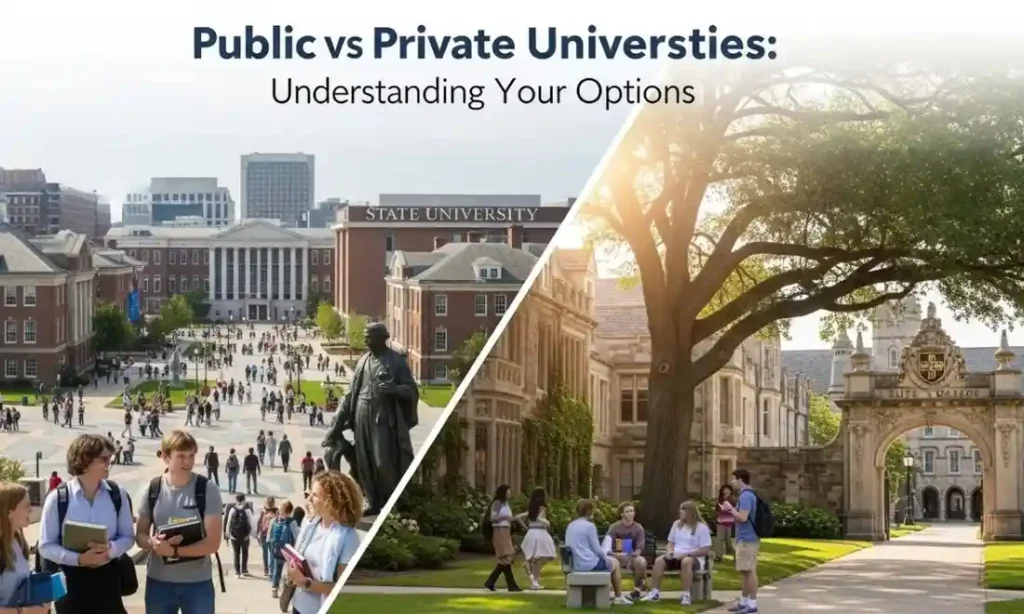
The best bachelor’s colleges in the USA at the same time also have the same set of franchises, which differ in the system and student experience. The difference between public and private institutions affects tuition and the classroom setting. Given these factors, this schism is one of the most important in American higher education.
Government funding allows public universities to offer lower tuition, particularly for in-state students. This is one of the victories of public institutions in the higher educational landscape. These institutions, along with the unique public status, cater to large student bodies of over 20,000, with some serving 40,000 students. Public universities can charge lower tuition fees while offering more than adequate education thanks to the subsidized government payments.
Contrarily, the private status of some institutions allows them to set flexible academic programs, but at the expense of higher tuition fees. These students, along with the intimate learning environments, lower student bodies of 2,000, and 15,000 offer more favorable student-faculty ratios.
Let’s take a look at some of the institutes with the best bachelor’s programs in the United States of America.
Top 15 Public Universities with Costs and State Locations

These American public universities best exemplify outstanding value and optimal educational offering. Their balance between international recognition and economic accessibility is commendable. Their commitment to public education and value offering is why they constantly strive and succeed in maintaining this balance.
| Rank | University | State | Annual Tuition (In-State) | Annual Tuition (Out-of-State) | QS Ranking 2025 |
| 1 | University of California, Berkeley | California | $14,226 | $46,326 | 12 |
| 2 | University of California, Los Angeles | California | $13,804 | $46,503 | 42 |
| 3 | University of Michigan, Ann Arbor | Michigan | $17,786 | $57,273 | 44 |
| 4 | University of Virginia | Virginia | $17,496 | $58,950 | 115 |
| 5 | University of North Carolina, Chapel Hill | North Carolina | $8,992 | $39,338 | 165 |
| 6 | University of Texas at Austin | Texas | $11,752 | $41,070 | 66 |
| 7 | University of California, San Diego | California | $14,733 | $48,630 | 82 |
| 8 | University of Florida | Florida | $6,381 | $28,658 | 215 |
| 9 | Georgia Institute of Technology | Georgia | $12,852 | $32,876 | 114 |
| 10 | University of Washington, Seattle | Washington | $12,242 | $42,000 | 76 |
| 11 | University of Wisconsin-Madison | Wisconsin | $10,796 | $39,000 | 116 |
| 12 | University of Illinois Urbana-Champaign | Illinois | $16,862 | $38,000 | 69 |
| 13 | Purdue University | Indiana | $10,948 | $38,000 | 89 |
| 14 | University of California, Davis | California | $14,597 | $46,043 | 127 |
| 15 | Ohio State University | Ohio | $12,485 | $36,000 | 149 |
How to Apply to Public Universities

- Application Submission: Online and offline options available, with digital applications being the standard. The Common Application is accepted by most public universities. Create accounts on university websites or the Common Application portal. Complete comprehensive application forms
- Required Documents: Personal statement and high school transcripts. Also included letters of recommendation and standardized test results (SAT/ACT). TOEFL/IELTS and financial documents for international students.
- Application Deadlines: Most deadlines typically fall between November and February. With early admissions, some benefits may come.
- Scholarship Opportunities: Merit scholarships, and need-based financial aid, and state programs. Many colleges offer automatic scholarships based on a student’s GPA as well as test scores.
Top 15 Private Universities with Costs and Details
The best private colleges and universities in America are the best of higher education. They provide incredible resources, faculty, and job opportunities. They can be expensive, but many also offer significant financial assistance that can make the cost reasonable.
| Rank | University | State | Annual Tuition | Acceptance Rate | Notable Programs |
| 1 | Princeton University | New Jersey | $65,210 | 5.3% | Engineering, Public Policy, Economics |
| 2 | Harvard University | Massachusetts | $54,269 | 3.4% | Medicine, Law, Business |
| 3 | Massachusetts Institute of Technology | Massachusetts | $63,250 | 4.8% | Engineering, Computer Science |
| 4 | Stanford University | California | $57,693 | 3.9% | Technology, Business, Engineering |
| 5 | Yale University | Connecticut | $67,250 | 3.9% | Law, Medicine, Liberal Arts |
| 6 | Columbia University | New York | $68,400 | 3.85% | Journalism, Business, Medicine |
| 7 | University of Chicago | Illinois | $68,200 | 5.4% | Economics, Business, Liberal Arts |
| 8 | University of Pennsylvania | Pennsylvania | $65,880 | 5.4% | Business, Medicine, Engineering |
| 9 | California Institute of Technology | California | $63,255 | 6.4% | Engineering, Physics, Chemistry |
| 10 | Johns Hopkins University | Maryland | $63,340 | 7.3% | Medicine, Public Health, Engineering |
| 11 | Northwestern University | Illinois | $66,200 | 7% | Journalism, Business, Engineering |
| 12 | Duke University | North Carolina | $65,420 | 6.4% | Medicine, Law, Business |
| 13 | Dartmouth College | New Hampshire | $69,207 | 6% | Liberal Arts, Business, Medicine |
| 14 | Cornell University | New York | $65,204 | 7.8% | Engineering, Agriculture, Veterinary |
| 15 | Rice University | Texas | $58,128 | 8.7% | Engineering, Business, Liberal Arts |
How to Apply to Private Universities
- Application Process: Private universities tend to have an application process that is not very different from public institutions. However, they may have additional specific essays and more predominant interviews.
- Holistic Admissions: Very frequently, highly ranked private universities employ holistic admissions which look at more than just test scores and GPA.
- Application Systems: Most of these institutions use the Common Application, but there are a few independent systems, including MIT and Georgetown, that universities use.
- Application Components: In addition to the planes, the full application process for some of these institutions may include advanced essays and show of zest through participation in extracurricular activities, follow up, and even more attendance activities including virtual events or campus events.
- Early Decision and Early Action: While most private colleges and universities have Early Decision and Early Action, Early Decision is more advantageous for students willing to make a commitment, but it is also more restrictive.
- Financial Aid: Financial Aid Distribution is typically more generous than that of public institutions, with many of the most elite private universities claiming to cover 100% of demonstrated financial need without loans. Colleges and universities that offer no-need financial aid policies fund the full cost of attendance for families who earn less than $100,000 a year.
Check out our latest blog - Cost of Masters Degree in USA: Complete Financial Guide for 2025
Bachelor’s Degree Cost Breakdown by Field of Study
There is a wide range of costs associated with acquiring a degree. STEM and other professional programs tend to be more expensive. This is a cost by field of study for the top Bachelor’s Colleges.
| Field of Study | Public Universities (In-State) | Public Universities (Out-of-State) | Private Universities |
| Engineering | $12,000 – $20,000 | $28,000 – $45,000 | $55,000 – $70,000 |
| Computer Science | $10,000 – $18,000 | $30,000 – $50,000 | $60,000 – $75,000 |
| Business Administration | $11,000 – $16,000 | $25,000 – $42,000 | $50,000 – $65,000 |
| Pre-Medical Programs | $13,000 – $22,000 | $35,000 – $55,000 | $60,000 – $80,000 |
| Liberal Arts & Humanities | $8,000 – $14,000 | $22,000 – $35,000 | $45,000 – $60,000 |
| Social Sciences | $9,000 – $15,000 | $20,000 – $38,000 | $40,000 – $58,000 |
| Fine Arts & Design | $10,000 – $17,000 | $25,000 – $40,000 | $50,000 – $70,000 |
| Communications & Journalism | $8,500 – $16,000 | $24,000 – $36,000 | $45,000 – $62,000 |
The tuition costs for STEM programs are higher because of the costs associated with laboratories, other specialized equipment, research facilities, and the faculty’s specialized training and expertise. At the same time, business programs offered at elite universities may cost as much as $70,000 a year, while liberal arts programs are more affordable and accessible across all institutions.
Monthly Living Expenses Breakdown

Other than tuition costs, students relocating will have to calculate enormous living costs, which differ immensely depending on region and efficiency. Below is a monthly cost estimate for students studying in the USA.
| Expense Category | Monthly Cost (USD) |
| Housing (Dorm/Shared Apartment) | $800 – $2,500 |
| Food & Dining | $300 – $600 |
| Transportation | $100 – $300 |
| Health Insurance | $200 – $400 |
| Textbooks & Supplies | $100 – $200 |
| Personal Expenses | $200 – $500 |
| Internet & Phone | $50 – $100 |
| Entertainment & Social | $150 – $400 |
Housing costs accounts for the big expenses. Major cities such as New York, San Francisco and Boston have prices which students would describe as ‘extortionate’. There are prices for accommodation in shared units, university housing and other colleges which will help student save money.
Conclusion
Us students can go to the best bachelor’s colleges in the USA in 2025, which cost between $8,000 and $70,000. This is for crossing the public and private sectors. Students applying need to consider the fit, finances, and the future. Out of all the other American colleges, the best balance between these diffuse factors is the one that offers educational affordability, long-term success, and growth opportunities.